

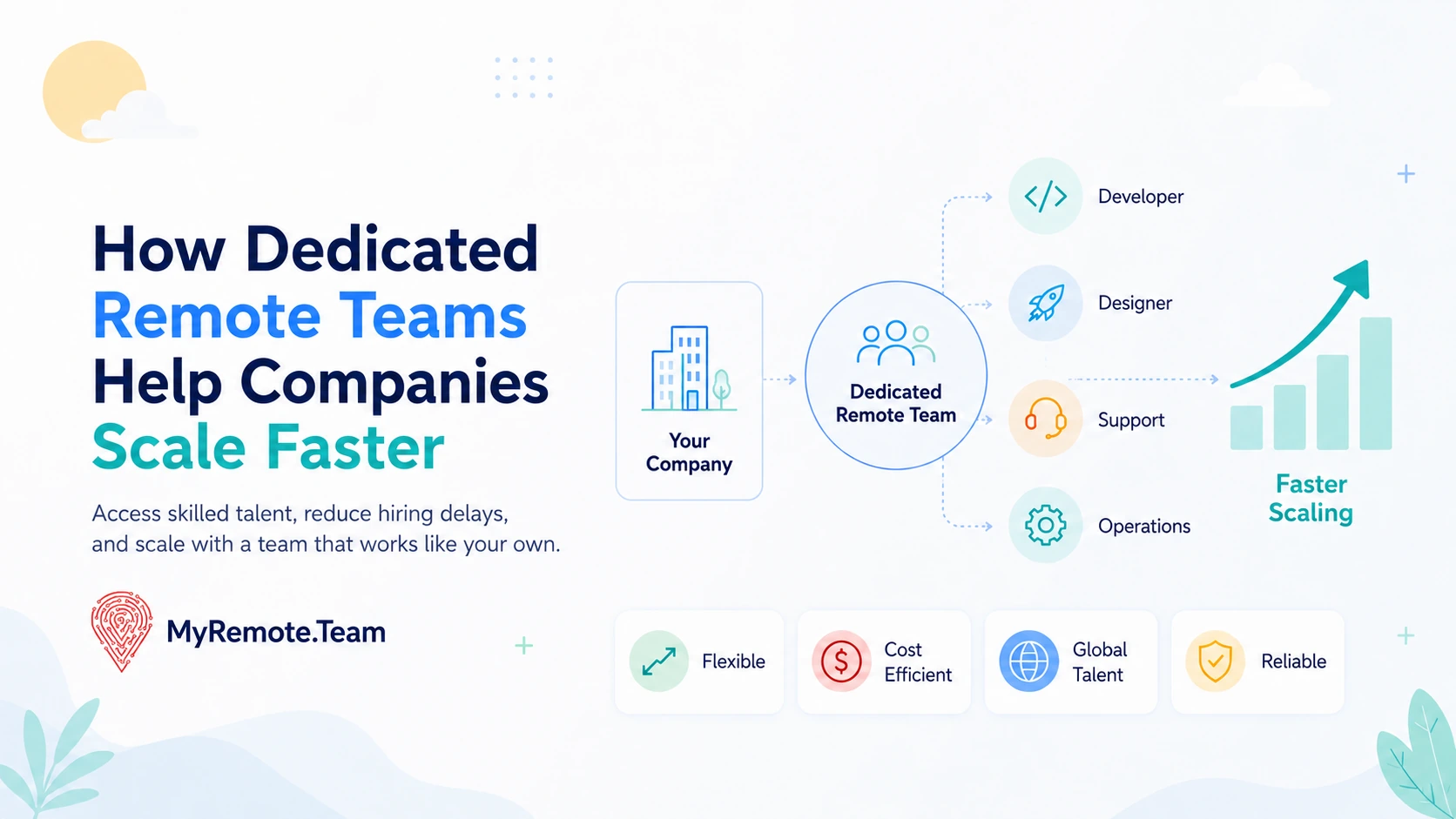
Scaling a company is exciting, but it also comes with pressure. New projects need to move faster, customers expect better experiences, and internal teams often reach a point where they can no longer handle everything on their own. For many companies, the biggest challenge is not finding new opportunities. It is finding the right people quickly enough to execute them.
Traditional hiring can be slow, expensive, and difficult to predict. Companies may spend months searching for developers, designers, marketers, support specialists, or operations talent, only to face delays, high salary expectations, and the risk of a poor fit. When growth depends on speed, long hiring cycles can become a serious obstacle.
This is why more businesses are turning to dedicated remote teams. Instead of hiring one person at a time or depending on disconnected freelancers, companies can build a reliable team that works as an extension of their business. A dedicated remote team gives companies access to skilled professionals, flexible capacity, and a faster way to grow without the complexity of building everything in-house.
In this article, we will look at how dedicated remote teams help companies scale faster, why this model is becoming more popular, and when it makes sense to use it as a smarter alternative to traditional hiring.
The Problem with Traditional Hiring
Traditional hiring can work well when a company has time, budget, and a strong internal recruitment process. But when a business needs to grow quickly, the classic hiring model often becomes too slow and too rigid.
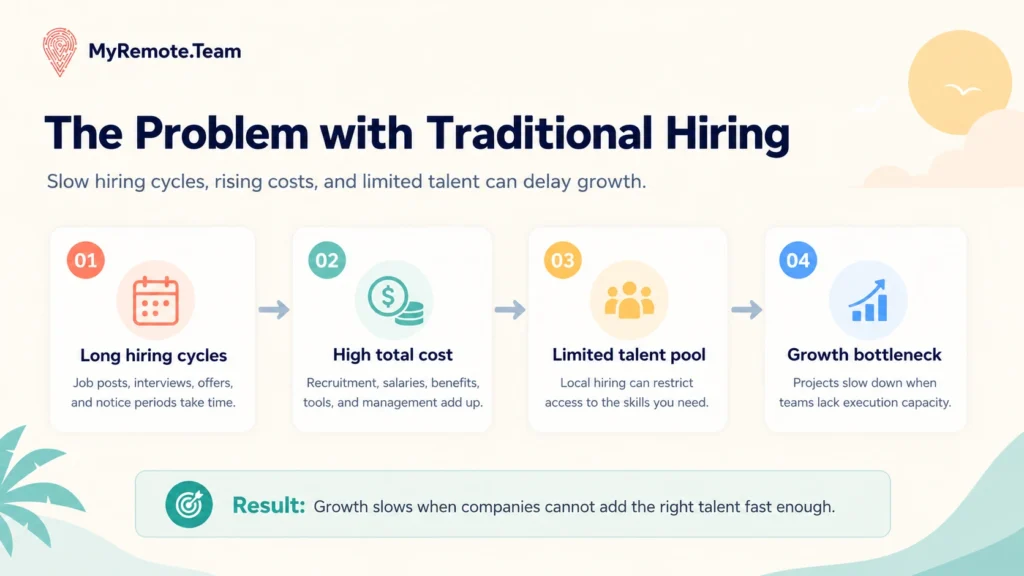
Finding the right people takes time. A company has to write job descriptions, promote open roles, review applications, interview candidates, negotiate offers, and wait for notice periods. In many cases, this process can take weeks or even months before the new team member actually starts working.
The problem is that business growth rarely waits. A product may need new features now. A marketing campaign may need to launch this month. Customer support may already be overloaded. Operations may need extra help immediately. When hiring takes too long, important opportunities can be delayed or missed completely.
Cost is another major challenge. Hiring full-time employees involves more than salary. Companies also have to think about recruitment costs, onboarding, management time, tools, benefits, taxes, office expenses, and the risk of turnover. If the person is not the right fit, the company may lose both time and money, then restart the entire hiring process again.
This is especially difficult for companies that need technical talent. Developers, designers, QA specialists, project managers, and digital specialists are in high demand. Strong candidates often have multiple options, and smaller companies may struggle to compete with larger employers that can offer higher salaries, stronger benefits, or bigger brand names.
For companies that want to scale, the traditional hiring model can create a bottleneck. The business may have the demand, the ideas, and the ambition to grow, but not enough people to execute fast enough.
What Is a Dedicated Remote Team?
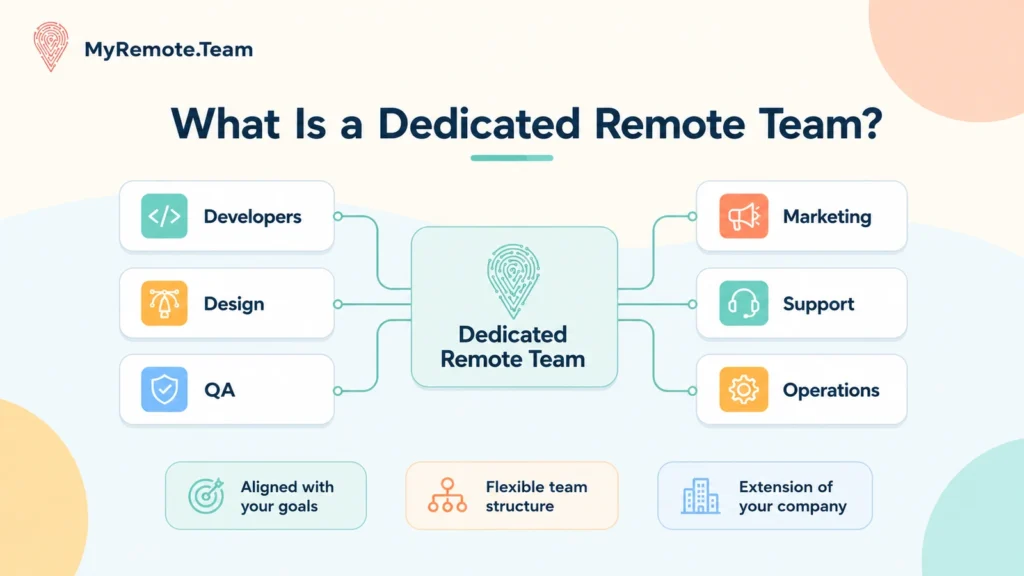
A dedicated remote team is a group of professionals who work remotely for your company, but stay focused on your projects, goals, and internal processes. Unlike freelancers who may work with multiple clients at the same time, a dedicated team is built around your business needs and becomes an extension of your company.
This team can include different types of specialists, depending on what your company needs. For example, a dedicated remote team may include software developers, UI/UX designers, QA testers, project managers, marketing specialists, customer support agents, virtual assistants, or operations staff.
The main advantage is flexibility. Instead of hiring every role internally, you can build a remote team with the exact skills you need at that moment. As your company grows, the team can grow with you. If your priorities change, the structure of the team can also be adjusted.
A dedicated remote team is not just about outsourcing random tasks. It is about creating a reliable working unit that understands your company, communicates with your internal team, and contributes to long-term growth. The team follows your direction, uses your tools, joins your workflows, and works toward your business objectives.
For many companies, this model offers the best balance between control, speed, and cost efficiency. You get access to skilled professionals without the delays and complexity of traditional hiring, while still maintaining a stable team that is aligned with your company’s goals.
Why Remote Tech Teams Are Becoming a Smarter Choice
Remote work has changed the way companies think about growth. In the past, many businesses believed that strong teams had to be built in the same office, in the same city, or even in the same country. Today, that is no longer the case. Companies can access skilled professionals from different markets and build strong teams without being limited by local hiring conditions.
For tech companies, startups, digital agencies, ecommerce businesses, and growing service companies, this creates a major advantage. Instead of competing only for local talent, they can work with experienced remote professionals who already have the skills needed to move projects forward.
Remote tech teams are also more flexible than traditional in-house teams. A company can start with a small team, test the workflow, and expand when the business needs more capacity. This makes growth easier to manage because the company does not have to commit too early to a large internal structure.
Another reason remote teams are becoming a smarter choice is speed. When a company needs to build a product, improve a platform, launch a new feature, manage customer support, or strengthen its operations, waiting months to hire internally can slow everything down. A dedicated remote team can help the company start faster and stay focused on execution.
Cost efficiency also plays an important role. Building an in-house team can be expensive, especially when salaries, recruitment fees, benefits, office costs, and management time are included. A dedicated remote team can give companies access to strong talent while keeping the overall structure more efficient and predictable.
Most importantly, remote teams allow companies to scale without losing focus. Instead of spending too much time on recruitment, administration, and repeated hiring processes, leaders can focus on strategy, product development, sales, and customer growth.
How Dedicated Remote Teams Help Companies Scale
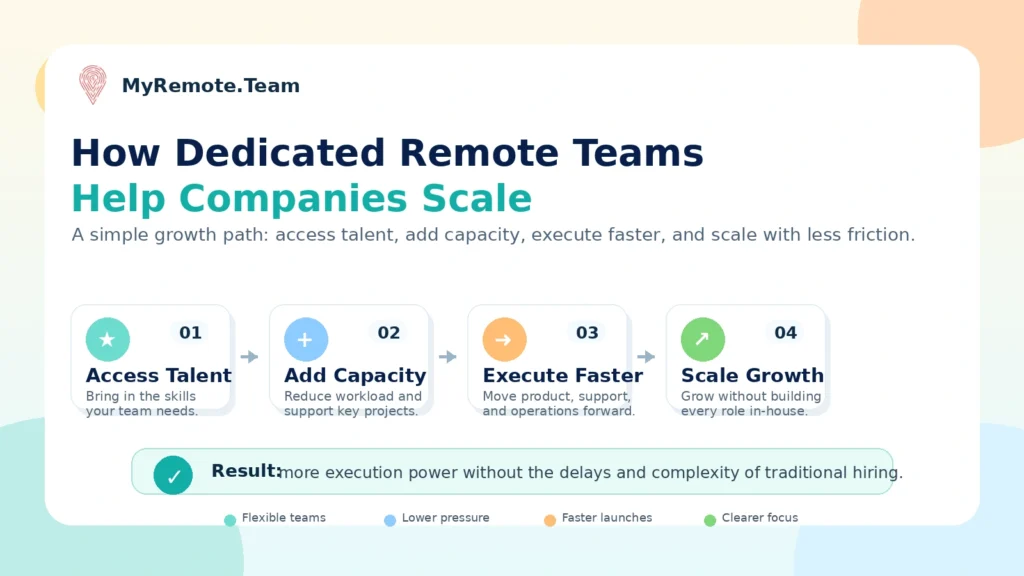
Dedicated remote teams help companies scale by giving them the people, skills, and capacity they need without the delays of traditional hiring. Instead of waiting months to build an internal team, a company can move faster by working with professionals who are ready to support specific projects and business goals.
One of the biggest advantages is speed. When a business is growing, timing matters. A delayed product launch, a slow development cycle, or an overloaded internal team can limit growth. With a dedicated remote team, companies can add capacity faster and keep important projects moving.
Another important benefit is access to specialized talent. A company may need developers, designers, QA testers, marketers, support agents, or operations specialists, but not always as full-time local employees. A dedicated remote team allows the business to bring in the right skills when they are needed, without being limited by the local talent market.
Dedicated remote teams also make scaling more flexible. A company can start with a smaller team and expand as the workload increases. This is especially useful for startups, agencies, SaaS companies, ecommerce businesses, and growing service companies that need to stay agile while managing costs carefully.
This model also reduces pressure on the internal team. When employees are forced to handle too many tasks, productivity drops and mistakes become more likely. A dedicated remote team can take over important work, support existing departments, and help the company operate with more structure.
For leadership teams, the value is clear: more execution power without unnecessary complexity. Instead of spending all their time hiring, training, and replacing people, company leaders can focus on strategy, customers, sales, and long-term growth.
In simple terms, a dedicated remote team helps a company grow faster because it removes one of the biggest bottlenecks in business: not having enough skilled people available at the right time.
Dedicated Remote Teams vs Freelancers vs In-House Hiring
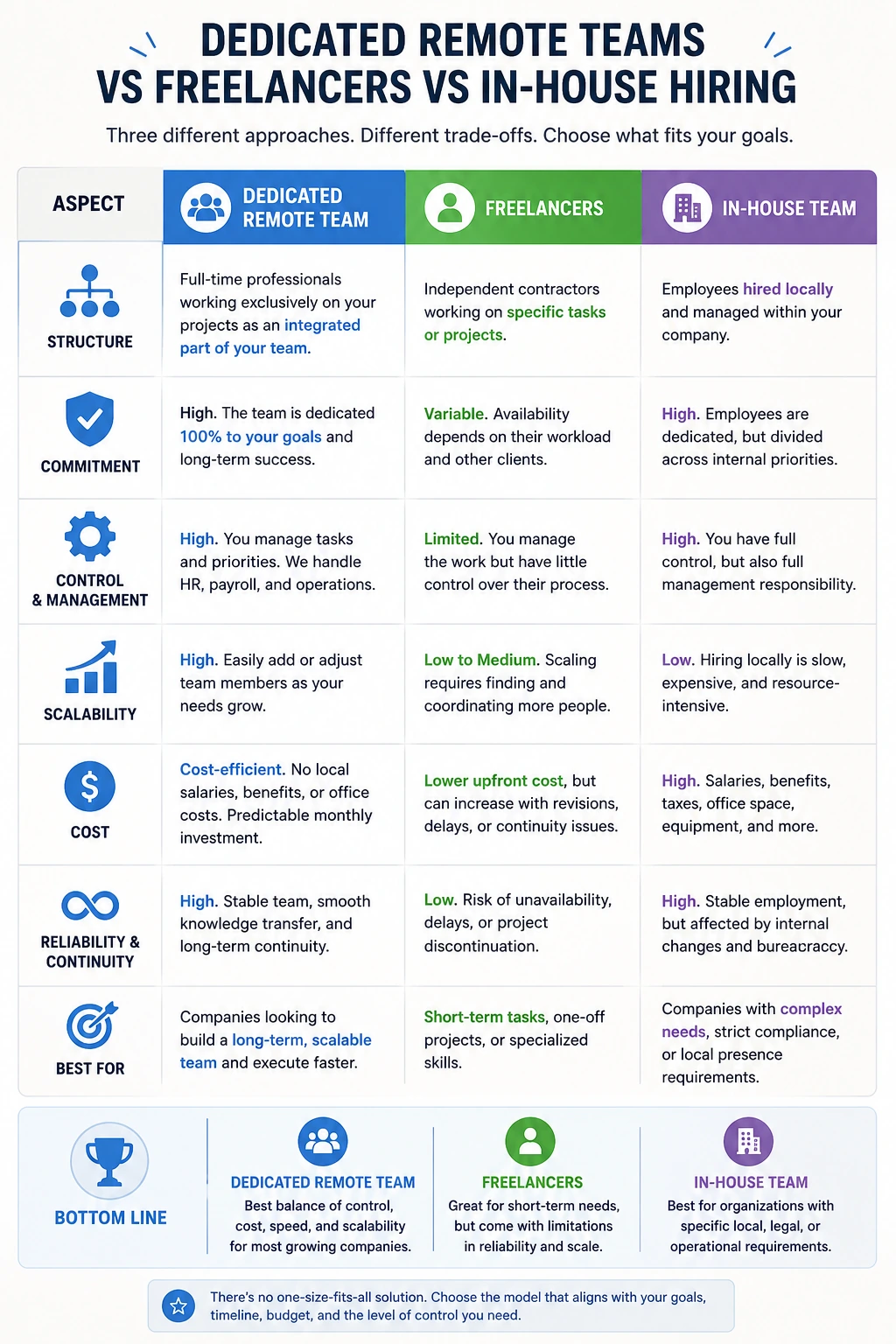
When a company needs more people, there are usually three main options: hire internally, work with freelancers, or build a dedicated remote team. Each model can be useful, but they are not the same.
In-house hiring gives companies the highest level of control, but it is also the slowest and often the most expensive option. It can take a long time to find the right candidates, complete interviews, negotiate salaries, and onboard new employees. This model works well for core leadership roles or long-term strategic positions, but it can slow down growth when the company needs to move quickly.
Freelancers can be a good choice for small tasks, short-term projects, or very specific assignments. They are usually flexible and easy to start with. However, freelancers may not always be available when needed, and they often work with multiple clients at the same time. This can make it harder to build consistency, long-term knowledge, and strong alignment with your internal team.
A dedicated remote team sits between these two models. It gives companies more stability than freelancers and more flexibility than traditional in-house hiring. The team works closely with your business, understands your goals, and can become part of your daily workflow without requiring the same time, cost, and administrative effort as building a full internal department.
For companies that need reliable execution, this difference matters. A dedicated remote team is not just a group of people completing random tasks. It is a structured team that can support product development, design, QA, marketing, customer support, operations, or other key business areas over a longer period of time.
The best model depends on the company’s goals. If you need full internal ownership, in-house hiring may be the right choice. If you need a quick one-time task, a freelancer may be enough. But if you need ongoing support, flexibility, and faster scaling, a dedicated remote team is often the smarter option.
When Should a Company Choose a Dedicated Remote Team?
A dedicated remote team is a strong option when a company has clear growth plans but does not want to slow down because of long hiring cycles. This model works especially well for businesses that need skilled people quickly, but still want more structure and reliability than they would usually get from freelancers.
One of the best moments to choose a dedicated remote team is when your internal team is overloaded. If your employees are constantly handling too many tasks, important projects can slow down and quality can suffer. A remote team can add extra capacity and help your existing team focus on the work that matters most.
This model also makes sense when your company needs specialized skills that are difficult to find locally. For example, you may need software developers, QA testers, designers, marketing specialists, customer support agents, or operations support. Instead of waiting months to hire each person internally, you can build a remote team around the exact roles your business needs.
A dedicated remote team is also useful when your company wants to launch a new product, improve an existing platform, expand into a new market, or support a growing customer base. In these situations, speed and consistency are important. Having a reliable team in place can help your business move faster and avoid unnecessary delays.
It can also be a good choice for companies that want to control costs while still growing. Hiring full-time employees in expensive markets can put pressure on the budget. A dedicated remote team gives companies access to strong talent while keeping the team structure more flexible and predictable.
In general, a company should consider a dedicated remote team when it needs long-term support, reliable execution, and faster access to talent, but does not want the complexity of building every role in-house from the beginning.
How MyRemote.Team Helps You Build the Right Team
MyRemote.Team helps companies build dedicated remote teams that are aligned with their goals, workflow, and growth plans. Instead of spending months searching for candidates, your company can access skilled professionals who are selected based on the roles, experience, and type of support you need.
The process starts with understanding your business. Every company has different priorities. Some need developers to speed up product development. Others need design, marketing, customer support, virtual assistance, project management, or operations support. MyRemote.Team helps you define what kind of team makes sense for your current stage and your long-term objectives.
Once the needs are clear, the focus is on finding the right people, not just filling positions. A poor fit can create delays, communication problems, and extra management work. That is why a dedicated team should be built around skills, reliability, communication, and the ability to work well with your existing team.
With MyRemote.Team, companies can grow their capacity without taking on the full complexity of traditional hiring. You can start with the roles you need most, then expand the team as your workload grows. This makes the model flexible, practical, and easier to manage than building a large internal team from the beginning.
The goal is simple: help your company move faster with a remote team that feels like a real extension of your business. Your dedicated team can support daily execution, help reduce pressure on internal staff, and give leadership more time to focus on strategy, sales, product development, and customer growth.
Whether you are building a new product, scaling an existing service, improving operations, or strengthening customer support, MyRemote.Team gives you a smarter way to access talent and grow with more confidence.
Final Thoughts
Scaling a company is not only about having bigger goals. It is also about having the right people in place to execute those goals. When teams are too small, overloaded, or limited by slow hiring processes, growth becomes harder than it should be.
Dedicated remote teams give companies a faster and more flexible way to build capacity. They help businesses access skilled professionals, support internal teams, reduce hiring delays, and move important projects forward without unnecessary complexity.
For companies that want to grow, launch faster, improve operations, or serve more customers, this model can be a practical alternative to traditional hiring. It offers the stability of a real team, the flexibility of remote work, and the speed needed in a competitive market.
With the right structure and the right people, a dedicated remote team can become more than external support. It can become a reliable extension of your company and a key part of your growth strategy.
If your business is ready to scale but hiring is slowing you down, MyRemote.Team can help you build a dedicated remote team that fits your goals, your workflow, and your next stage of growth.
FAQ
What is a dedicated remote team?
A dedicated remote team is a group of professionals who work remotely for your company and focus on your projects, goals, and daily operations. The team acts as an extension of your business, instead of working as separate freelancers on disconnected tasks.
How can a dedicated remote team help a company scale faster?
A dedicated remote team helps a company scale faster by giving it access to skilled people without the long delays of traditional hiring. This allows the company to increase capacity, move projects forward, support internal teams, and respond faster to business opportunities.
Is a dedicated remote team better than hiring freelancers?
It depends on the company’s needs. Freelancers can be useful for short-term tasks, but a dedicated remote team is usually better for ongoing work, long-term support, and stronger alignment with the company’s workflow. A dedicated team offers more stability, consistency, and reliability.
What roles can be included in a dedicated remote team?
A dedicated remote team can include software developers, UI/UX designers, QA testers, project managers, marketing specialists, customer support agents, virtual assistants, operations staff, and other professionals, depending on the company’s needs.
When should a business choose a dedicated remote team?
A business should consider a dedicated remote team when it needs to grow quickly, reduce pressure on internal staff, access specialized talent, or avoid long and expensive hiring cycles. This model is especially useful for companies that need ongoing support and flexible capacity.
Can a dedicated remote team work with our existing internal team?
Yes. A dedicated remote team can work directly with your internal team, use your tools, follow your processes, and join your existing workflows. The goal is to create a smooth collaboration where the remote team feels like a real part of your company.
How does MyRemote.Team help companies build remote teams?
MyRemote.Team helps companies understand what roles they need, find the right professionals, and build dedicated remote teams that fit their goals, workflow, and growth plans. This gives companies a faster and more flexible way to scale without the complexity of traditional hiring.